The Bug Light Boys — Episode 1: You’re Fine
By Lloyd W. Alexander
Most people drove right past the place.
That was one of the reasons he liked it.
There was nothing about the approach that suggested sanctuary. South Portland gave you industry first: oil tanks rising behind fences, pipes and utility structures, patches of high grass, chain-link, scrub, and the hard geometry of a working waterfront. The road curved toward the public boat launch and the little park near Bug Light, where people came to fish, walk dogs, jog, sit in their cars, or stare across the harbor.
Across the water, Portland sat in the distance.
Home.
He had been born there and raised there. From this side of the harbor the city looked almost small enough to hold in one hand, its buildings stacked behind the water as if the whole place had been arranged for a photograph. He knew better. A city could look simple from a distance. So could a life.
He had started coming here because the college was nearby.
Not to the college exactly. Not yet. That was the problem.
He was taking classes online and trying to work his way toward something that should have been ordinary: walking onto campus, going inside, sitting in a room with other people, and staying there. Some days he could get close. Some days getting close was the accomplishment.
So he made deals with himself. He did not have to walk into a classroom today. He did not have to talk to anyone. He only had to drive a little closer. Sit for a while. Read. Study. Let his body learn that being near the place did not mean something terrible was about to happen.
The tucked-away stretch near the curve was good for that because almost everybody passed it.
And if nobody stopped, he could be nobody too.
His camera helped.
He had carried one for so many years that it felt less like equipment and more like an extension of himself. Put a camera in front of his face and the world changed. He was not a man standing alone wondering where to put his hands or whether someone was looking at him. He was a photographer. He had a reason to be there. A purpose. Something between him and everybody else.
A Linus blanket with a lens.
He could photograph gulls, boats, the skyline, the occasional fox slipping through brush, or nothing at all. The subject almost did not matter. The camera did.
He had noticed the older men before.
Three vehicles, sometimes four or five, parked along the right side. Folding chairs tucked back in the brush. Men talking. Sometimes laughing loudly enough that he could hear them from the road. They seemed to have claimed a little corner without actually claiming it, clearing enough brush to sit while leaving the place almost invisible to anyone who did not know to look.
When they were there, he usually kept going.
That afternoon he rounded the curve and saw one vehicle.
His stomach tightened before he had time to think about it.
He could leave. Easy. Start the truck, pull out, go farther down toward the park. Nobody would care. Nobody would even know why.
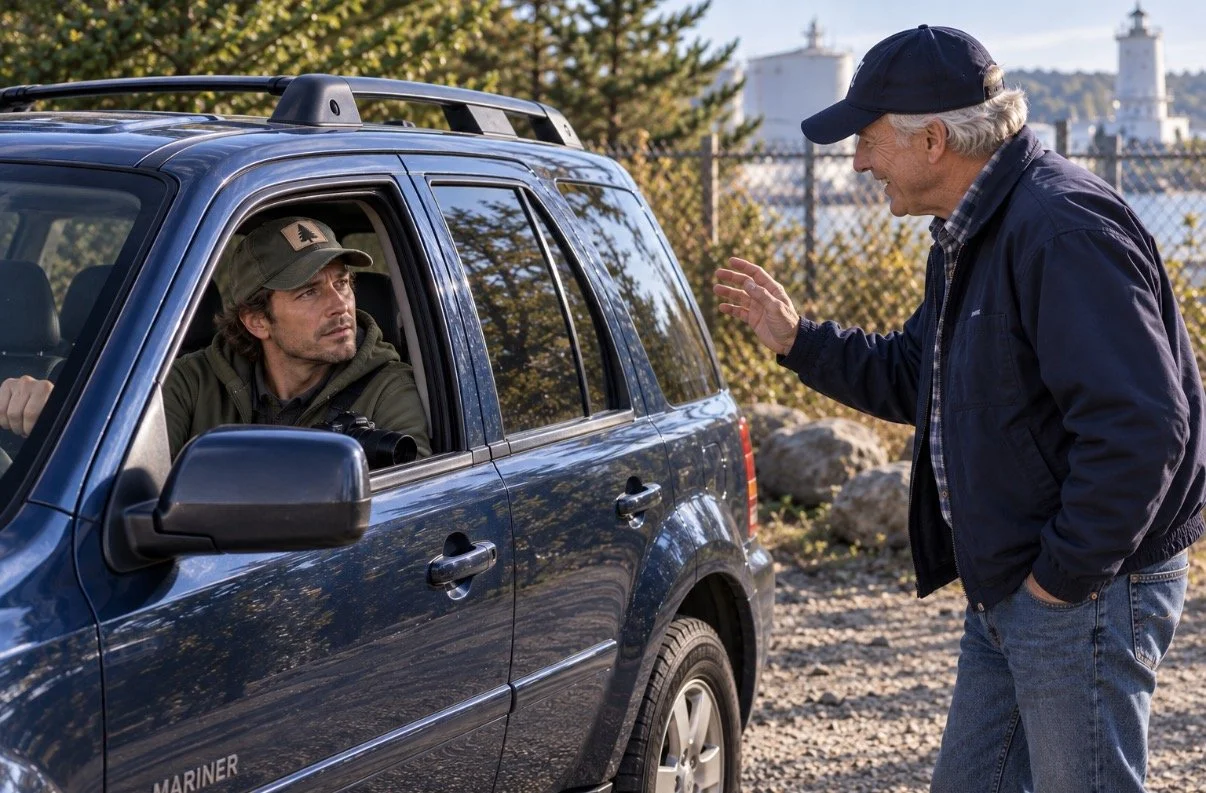
He had already begun gathering his things when he saw the man coming toward him.
Older. Early seventies maybe. Solidly built. A cap. Clean, neat, the kind of posture that made him look relaxed without ever looking careless. He did not hurry. He did not wave Eagle Eye down or approach as if he had caught him doing something.
He simply walked over.
“How you doing?”
“Good.”
The answer came automatically.
The man glanced at the camera.
“You take pictures?”
“Yeah.”
“Wildlife?”
That was easier.
“Mostly. Wildlife. Nature. Whatever I find.”
The man nodded as if that were a perfectly sufficient explanation for why somebody might sit alone beside a patch of brush near an industrial waterfront.
They talked for another minute. Birds. Foxes. The things that came through the area. Nothing important, which somehow made it easier.
Eagle Eye looked toward the chairs.
“I can get out of your way. I know you guys hang out here.”
The man looked at him.
“Our way?”
Eagle Eye gestured vaguely toward the clearing.
“Here.”
“We don’t own it.”
“I know. I just—”
The man looked back toward the brush, then at him again.
“It’s a good place to sit.”
“It is.”
“Doesn’t mean you have to leave.”
“Oh.”
The man gave the smallest shrug.
“You’re fine.”
That was all.
No speech. No invitation that required an answer. No questions about why a thirty-five-year-old man was sitting alone near a college instead of being at the college. No demand that he explain himself.
You’re fine.
The words should not have mattered as much as they did.
The man introduced himself as Charlie.
Charlie eased into one of the folding chairs, leaving another empty beside him. He didn’t ask Eagle Eye to sit. He simply made it possible.
Eagle Eye hesitated for a moment, then lowered himself into the empty chair, his camera resting against his knee.
Charlie sat straight without seeming stiff. Even his cap looked carefully placed.
“Can I ask you something?” Eagle Eye said.
“Sure.”
“Were you in the military?”
Charlie smiled. “Does it show?”
“A little.”
“Navy first. Then the Army.”
“Both?”
“Well, I was young. Thought I ought to see what everybody had to offer.”
“What happened with the Army?”
“They wanted me driving a tank.” Charlie glanced toward the harbor. “I decided I liked being able to see the sky.”
Eagle Eye laughed. “So you left?”
“Eventually. Ended up in the Coast Guard. Search and rescue.”
“You were a rescue swimmer?”
“Rescue jumper, back then. Things were different.” He watched a gull circle above the water. “The swimmers today have some remarkable equipment, and they do remarkable work. We didn’t have all that. I used to jump in my dungarees.”
“Dungarees? Into the ocean?”
“Water didn’t care what you called your pants.”
Eagle Eye tried to picture the cold, the waves, the helicopter overhead.
“Did you save people?”
Charlie’s smile faded into something quieter. He looked toward the fence opening.
“Twenty-five,” he said.
“Twenty-five people?”
Charlie gave a small nod. “Something like that.”
“That’s incredible,” Eagle Eye said.
“They needed help.” Charlie took a sip, then nodded toward the camera. “You probably see things the rest of us miss.”
It surprised Eagle Eye that Charlie would turn the conversation back to him. A man who had pulled people from the ocean wanted to know what he saw through a lens.
Eagle Eye smiled. “Sometimes you learn where to look.”
Charlie nodded toward the camera.
“Well, maybe you can show me sometime.”
Then a vehicle came slowly around the curve and pulled in.
Charlie glanced over.
“Here comes Donnie.”
Donnie was a large man, heavy but strong-looking, with the kind of face that seemed halfway through a story before he had even reached the chairs. He got out talking.
Within minutes Eagle Eye learned that Donnie had been a Marine, that being a Marine apparently explained most things, and that he claimed to do three hundred push-ups a day.
Charlie looked at him.
“Uh-huh.”
Donnie kept going.
Charlie waited.
“That sounds like bullshit.”
Donnie looked offended.
“Marine.”
Charlie nodded once.
“I’m just saying.”
Something escaped Eagle Eye before he could stop it.
A laugh.
Donnie heard it and pointed at him as if he had just gained a witness for the prosecution.
“See? He knows.”
Charlie looked toward Eagle Eye.
“He knows something.”
That made Eagle Eye laugh again, and this time Charlie smiled too.
Another vehicle appeared.
Charlie looked toward the road.
“There’s Donnie.”
Eagle Eye looked at the large man beside him, then back toward the arriving truck.
“I thought he was Donnie.”
“He is.”
The second Donnie climbed out. Thin, wiry, hat, glasses, cigarette. He had the expression of a man who had already found three things wrong with the afternoon and was deciding whether any of them were worth mentioning.
Eagle Eye looked from one to the other.
“So you’re both Donnie.”
The thin one looked at him through his glasses.
“That’s usually how names work.”
Big Donnie laughed hard enough for everybody.
Eagle Eye smiled and looked down, but he did not leave.
He ended up sitting with them.
At first he kept the camera close. Not necessarily in front of his face, but close enough. His hand rested on it now and then, checking that it was there.
The men talked the way people talk when they have nowhere else they need to be. A story about somebody’s truck turned into an argument about engines. That became a story about the Marines. Charlie corrected one detail. Big Donnie accused him of ruining a perfectly good story. Slim Donnie said it had been ruined before Charlie got involved.
Nobody seemed concerned with reaching a conclusion.
A movement near the fence caught Eagle Eye’s attention.
His head turned before anyone else’s did.
Something had shifted low in the brush near the opening where vines and branches almost swallowed the chain-link.
“There,” he said.
The others looked.
“Where?” Big Donnie asked.
Eagle Eye pointed, then stopped himself from pointing directly at the spot. Too much movement could push an animal back.
“Near the fence. Low. Just left of that thicker branch.”
Slim leaned forward.
“I don’t see anything.”
“It moved behind the brush.”
“Fox?” Charlie asked.
“Could be.”
They waited.
A small shape appeared for half a second and vanished again.
Big Donnie grinned.
“How the hell did you see that?”
Eagle Eye shrugged.
He had no useful answer. He just saw things.
They started asking questions. Where did the animals come through? Did they use the same routes? Why that opening? Would a fox keep coming back with people sitting here?
Those questions were easier than questions about himself.
He explained what he had learned from years of watching wildlife: animals noticed patterns, routes became familiar, and a place could become safe if nothing there gave them reason to fear it. People often assumed an animal saw a human and thought only one thing—danger—but behavior was more complicated than that. Animals watched. Learned. Decided.
Slim pushed his glasses higher.
“If they’re that cautious, why come through with all of us sitting here?”
The question landed differently in Eagle Eye’s head than Slim intended.
He immediately wondered if he had explained it wrong.
Maybe he had sounded stupid. Maybe he had talked too much. Maybe Slim knew more about this than he did and was politely pointing out the hole in his reasoning.
His mind started building the usual courtroom.
Then he looked at the fence again.
“Because you’re predictable,” he said.
Slim stared at him.
Eagle Eye kept going before he could lose the thought.
“You sit here. You talk. You don’t chase them. They know where you are. They know the opening. If they’ve used it enough without anything bad happening, you become part of the place.”
Slim considered that.
“Huh.”
That was it.
No correction. No ridicule. No evidence that Eagle Eye had committed some social error requiring three days of analysis.
Just huh.
A plane crossed overhead later.
Slim looked up and identified it almost immediately.
Charlie disagreed with one detail.
Slim told him why he was wrong. Charlie told Slim why he was wrong. Big Donnie contributed something that neither of them believed. The plane continued across the sky, apparently unconcerned with the dispute below.
Eagle Eye listened.
Something about the exchange settled in him.
Nobody here knew everything.
Everybody knew something.
And nobody seemed threatened by the difference.
The afternoon moved without announcing itself.
Cars passed. Joggers went by. A boat moved across the harbor. Somewhere beyond the brush the city continued doing what cities did.
Eagle Eye realized his camera was sitting beside him.
He had not touched it in a while.
That almost never happened around people.
Usually some part of him remained outside himself, watching: Where are your hands? Are you sitting strangely? Did that joke land? Did you talk too long? Was that look annoyance? Should you leave before they want you to leave?
But the men kept talking.
Big Donnie exaggerated. Slim corrected him. Charlie occasionally dropped a sentence into the middle that made both Donnies stop long enough to decide whether he had insulted them.
Nobody examined Eagle Eye.
Nobody asked him to perform.
They simply made room.
It felt strangely familiar.
Not socially familiar. He did not have much of that.
It felt like being in the woods waiting for an animal. Like standing over a faceoff before the puck dropped. Like the seconds after a quarterback took the snap and everything unnecessary disappeared.
Present tense.
No yesterday. No ten minutes from now. No replaying the sentence he had just said.
Just here.
Eventually he stood to leave.
He picked up the camera.
Charlie looked over.
“Probably be around tomorrow.”
Eagle Eye nodded.
“Good meeting you.”
“You too.”
He drove away.
For the next few days he thought about the place more than he expected.
Not constantly. Not dramatically.
Just little pieces.
Charlie saying, You’re fine.
Big Donnie’s three hundred push-ups.
Slim Donnie looking at him and saying, That’s usually how names work.
The fox—or whatever it had been—moving through the brush.
The camera sitting untouched beside him.
Then one afternoon he came around the curve again.
The vehicles were there.
His old instinct arrived right on time.
Keep going.
Nobody had invited him back, not exactly. Charlie had said they would probably be around. That was not the same thing. He could drive to the park. He could find somewhere else. He could avoid the possibility of discovering that the first afternoon had meant more to him than it had to them.
The turn came closer.
He could keep going.
He touched the brake.
Then turned in.
Big Donnie saw him first.
“There he is!”
Charlie looked over and smiled.
Slim gave him a nod.
Nothing dramatic happened.
Nobody applauded. Nobody asked why he had come back.
There was simply a place to park and a place to sit.
Across the harbor was Portland, the city where he had grown up.
Nearby was the college he was trying to become brave enough to enter.
And between them, in a forgotten patch beside an industrial road, a few older men had made room for him without asking him to become anybody first.
He reached for the camera.
His hand stopped.
He looked toward the chairs.
Then he left the camera in the car.
He thought about what Charlie had said to him that first afternoon.
You’re fine.
Two simple words. Nothing extraordinary to the man who had spoken them, but to Eagle Eye, they had meant more than Charlie could possibly know.
For now, he didn’t need the camera.
He got out.
And stayed.
— — —
Continue Reading
Bonus Artwork
Stay Connected
New episodes, bonus stories, artwork, and other surprises will be released as they’re ready.
Join the Collective — Sign Up for Updates
© 2026 Lloyd W. Alexander. All rights reserved.